

Womble Bond Dickinson Carbon Reduction Plan
Contents
Commitment to achieving net zero
Baseline emissions footprint
Current emissions reporting
Emissions reduction targets
Carbon reduction projects
Declaration and sign off
1. Commitment to achieving net zero
Being a responsible business is at the heart of our commitment to building an ever more sustainable, inclusive and progressive business. It's a recognition of the part we must play in balancing our social, environmental and economic goals for the future of our people, our communities and our planet. As a firm, we cannot operate as a single silo separate from the communities and environment we live and work in.
Developing and stretching our environmental targets is core to our business, which is why back in 2021 we committed to being a Net Zero business by 2030.This commitment, based on the data available to us at the time, has helped us achieve some amazing progress during that period, particularly in terms of scopes 1 and 2 emissions reduction. Since then one of our key aims has been to build a better understanding of our scope 3 emissions impact and we are now at a key point in our journey, establishing SBTi (Science Based Targets Initiative) validated targets and an updated roadmap to Net Zero emissions. This will be communicated shortly and any update to our Net Zero targets will be underpinned by the values driving our initial commitment.
Our firm has already reached some impressive milestones: we procure renewable energy in five of our eight UK offices, with over 77% of the electricity used across the UK during 2024/25 certified renewable. Our firm recently achieved a 58.99% decrease in location based scope 1 and 2 emissions compared to the baseline year (2019/20) and successfully retained our EcoVadis Gold rating, ranking the firm in the top 3% of companies rated over the previous 12 months.
Our approach and focus is led from the top down, by our Chair, Alexander Dickinson and Partner Lead for Responsible Business, Sally Dallow. Sally leads our Responsible Business Steering Group who oversee our Responsible Business activity and meet on a quarterly basis. We also have a Net Zero partner, Jon Bower, who leads a committed Net Zero Team who meet regularly to focus our activity.
To further help us deliver on our Net Zero commitment, we have over 35 environmental representatives across our eight office locations. They support our Environment, Health & Safety (EHS) Team in maintaining an effective environmental management system and driving firmwide and regional environmental initiatives. We are also founding and active executive members of the Legal Sustainability Alliance (LSA), members of the Bristol Climate Leaders Group and signatories of the Team London Bridge Decarbonisation Charter.
Further information regarding our environmental commitment and focus can be found in our Environmental Policy Statement and our Environment - Responsible Business Report on our website.
2. Baseline emissions footprint
Baseline emissions are a record of the greenhouse gases that have been produced in the past and were produced prior to the introduction of any strategies to reduce emissions.
Baseline emissions are the reference point against which emissions reduction can be measured.
| Baseline Year: 1 May 2019 to 30 April 2020 | |
| Additional details relating to the baseline emissions calculations. | |
Baseline reporting year and first year of SECR (Streamlined Energy and Carbon Reporting). Both Market based and Location based figures included. Figures certified by the Planet Mark, who also assist with our SECR submission. Primarily scope 1 and 2 emissions, with five scope 3 emissions categories included – Upstream Transportation & Distribution, Waste Generated in Operations, Business Travel, Employee Commuting and Downstream Transportation and Distribution. | |
| Baseline year emissions: | |
| EMISSIONS | TOTAL (tCO2e) |
| Scope 1 | 658.4 |
| Scope 2 | 425.8 (Market Based), 591.9 (Location Based) |
| Scope 3 | Category 4 (Upstream Transportation and Distribution) – 54.2 Category 5 (Waste Generated in Operations) – 20.7 Category 6 (Business Travel) – 586.1 Category 7 (Employee Commuting) = 1097.6 Category 9 (Downstream Transportation and Distribution) – 28.3 Total – 1786.9 |
| Total Emissions | 2871.1 (Market Based), 3037.2 (Location Based) |
3. Current emissions reporting
| Reporting Year: 1 April 2024 to 31 March 2025 | |
| EMISSIONS | TOTAL (tCO2e) |
| Scope 1 | 199.2 |
| Scope 2 | 188.4 (Market Based), 313.5 (Location Based) |
| Scope [1] | Category 4 (Upstream Transportation and Distribution) – 0.9* Category 5 (Waste Generated in Operations) – 2.4 Category 6 (Business Travel) – 384.3 Category 7 (Employee Commuting) = 468.1* Category 9 (Downstream Transportation and Distribution) – 7.1* Total – 862.8 |
| Total Emissions | 1250.4 (Market Based), 1375.5 (Location Based) |
Note: All rows are rounded to one decimal place which may lead to a slight discrepancy in the total emissions figures.
4. Emissions reduction targets
In order to continue our progress towards achieving Net Zero, we are committed to achieving the following carbon reduction targets:
- Reduce emissions associated with travel by 50% by 2026
- Set a minimum standard for EPCs of C in buildings through acquisition; BREEAM; refurbishments etc
- Reduce paper consumption by 60% by 2026
- Increase the percentage of recycled waste across all offices whilst reducing emissions associated with waste by 50% by 2026
- Work with our Landlords and Managing Agents to ensure our buildings source 100% renewable energy wherever possible by 2026 [2]
- Eliminate single-use plastic wherever possible, working in partnership with our suppliers including our catering contractor VacherinBased on current scope of reporting, we would project that carbon emissions will have decreased by at least 1626 tCO2e from the baseline year, in-line with the recommended year on year reduction target of 12% recommended by Planet Mark to maintain a trajectory towards Net Zero by 2050 at the latest.
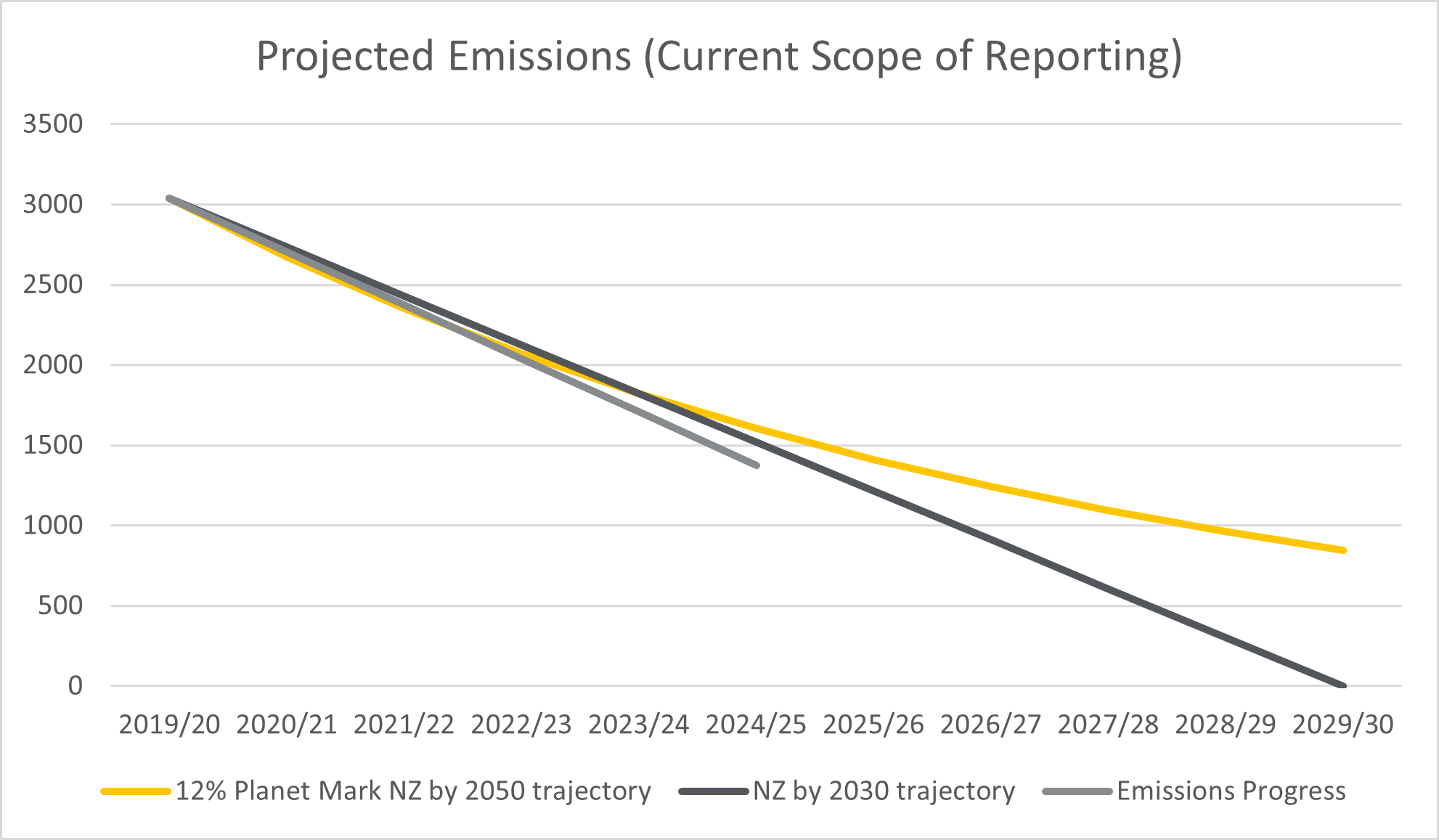
However it is important to note the projection above will be updated as a result of imminent changes to our scope of reporting, an integral element of our progression towards a Net Zero target by 2030. The current emissions reporting is primarily focused around scope 1 and 2 emissions, with several scope 3 emissions categories included. We will broaden the extent of our scope 3 reporting to include significant emissions categories such as procured goods and services as part of our annual emissions reporting. With the introduction of new reporting categories, we anticipate an initial increase in total emissions but recognise this is a vital step in our progression towards our Net Zero goal and Science Based Targets initiative (SBTi) certification.
5. Carbon reduction projects
The carbon emission reduction achieved equates to 1661.7 tCO2e, a 54.71% reduction against the 2019-20 baseline. The reduction across scopes 1 and 2 equates to 737.6 tCO2e, a 58.99% reduction.
The following environmental management measures and projects have been completed or implemented since the 2019-20 baseline:
- Publication of our Net Zero Action Plan which further details our commitment to Net Zero
- Retention of the EcoVadis Gold Medal for the third consecutive year, placing us in the top three percent of nearly 89,000 companies assessed this year whilst increasing our overall score by five points. EcoVadis assesses criteria across four themes: Labour & Human Rights, Ethics, Environment and Sustainable Procurement
- Refreshed our travel policy, further aligning our policy with our Net Zero ambitions and encouraging colleagues to consider sustainable travel alternatives wherever possible. Our most recent policy launch featured a 'carbon fee' on business class air travel as we aim to address the most significant areas of business travel emissions impact
- Maintained ISO 14001 certification since 2017, recognising a framework is in place for continuous environmental performance improvement
- Invested in training to further develop the skills and knowledge base of our people in relation to sustainability and carbon emissions reduction – examples include IEMA training courses and Net Zero awareness workshops
- Engaged our colleagues in further Firmwide commuting surveys, helping us better understand the impact of commuting habits on carbon emissions and identify key areas of opportunity to promote sustainable commuting alternatives such as cycling through our Cycle to Work scheme
- Completed refurbishment of our London, Leeds, Bristol and Plymouth offices, incorporating a full upgrade to LED lighting
- Implemented key findings and recommendations from energy audits and TM44 inspections, including an increase of set temperatures for our AC units in server rooms
- Installed PIR sensor lighting wherever possible at our offices
- Invested significantly in video conferencing technology at our offices
- Upgraded to Microsoft Teams and enhanced remote working technologies to help reduce the requirement for travel
- Relocated to a BREEAM building (The Spark | Our Vision | Newcastle Helix) that meets the Fitwel standard, supporting a healthier workplace environment and improving occupant health and productivity. This building utilises geothermal activity to help heat and cool the building through a network of underground pipes. Over a third of the Firm (400+) are based across 37,547 sq. ft of the new building
- Reconfigured our space at our Leeds, Bristol and London offices, consolidating our office spaces and significantly reducing our space footprint. Installation of LED lighting in our London office ensures all our office space is now fully LED.
Looking ahead, as we continue our progress towards a Net Zero target, we have a number of current and proposed projects that will aid us on this journey. These include:
- Submission of an SBTi (Science Based Targets initiative) target for validation by Q1 of 2026
- Broadening the extent of our scope 3 emissions reporting as part of our annual emissions reporting scope. To facilitate a more comprehensive assessment of the emissions associated with our supply chain, we will also continue to enhance our procurement strategy which includes a Supplier Code of Conduct
- Engage further with our supply chain to better understand the emissions impact in this area, opportunities for improvement and work collaboratively to maximise the impact of our emissions reduction efforts. This will include several supplier engagement workshops hosted by WBD
- Enhancing our internal environmental training programme as well as hosting a number of seminars and workshops in partnership with our environmental consultants, both aimed at raising further awareness and enhancing engagement amongst colleagues at WBD
- Continuing with initiatives such as our EnviroNovember campaign and Net Zero week, aimed at raising awareness of Net Zero and inspiring carbon reduction ideas and initiatives
- Take onboard opportunities to further reduce scopes 1 and 2 emissions based on recommendations from energy audits, notably our recent ESOS phase 3 energy audits
- Continue to enhance the quality of our data, ensuring our reporting is robust, comprehensive and backed up by evidence
- Taking all opportunities to review and rationalise our office footprint in line with our hybrid working model, helping to significantly reduce our emissions
- Working closely with our Mechanical & Electrical Services consultants to monitor, assess and review our assets and plant - identifying any further opportunities to increase energy efficiency in our operations including introducing new technologies such as remote sensors
6. Declaration and sign off
This Carbon Reduction Plan has been completed in accordance with PPN 006 and associated guidance and reporting standard for Carbon Reduction Plans.
Emissions have been reported and recorded in accordance with the published reporting standard for Carbon Reduction Plans and the GHG Reporting Protocol corporate standard and uses the appropriate government emission conversion factors for greenhouse gas company reporting.
Scope 1 and Scope 2 emissions have been reported in accordance with SECR requirements (where required), and the required subset of Scope 3 emissions have been reported in accordance with the published reporting standard for Carbon Reduction Plans and the Corporate Value Chain (Scope 3) Standard.
This Carbon Reduction Plan has been reviewed and signed off by the board of directors (or equivalent management body).
Signed on behalf of Womble Bond Dickinson (UK) LLP:
Sally Dallow, Partner Lead for Responsible Business
Alexander Dickinson, UK Chair
19 May 2026
Footnotes:
[1] Wherever possible, figures included represent the latest reporting period (2024/25). Some scope 3 category figures (marked with an *) will be representative of the most recent reporting period for which we have verified extended scope 3 emissions (2022/23) available. For those categories, we expect to have data available during Q1 of calendar year 2026 when those figures and this document will be fully updated, incorporating all relevant scope 3 categories.
[2] In some buildings such as our Newcastle location where we benefit from the District Energy Centre (CHP), renewable energy categorisation may not be option. In any instances such as this, we will work with our Landlords and Managing agents to ensure operations are as energy/carbon efficient as possible.