
Alerts
Functional Or Ornamental? An Accused Infringer’s Cited Prior Art May Narrow Design Patent Claim Scope
Mar 12 2026
A design patent may include only one claim and it “shall be in formal terms to the ornamental design for the article.” But the scope of the claimed design must be construed in order to identify those ornamental, or non-functional aspects of the design. So said the Federal Circuit in a precedential decision issued February 2, 2026, in Range of Motion Products v. Armaid Company Inc..
One factor the Federal Circuit looked to for construing the claimed design at issue in RoM was the accused infringer’s own utility patent which was cited during prosecution of the asserted design patent. Design patent owners should be aware of such art and potential impacts on the scope of their patented designs.
For example, based in part on the accused infringer’s utility patent, with utility claims covering certain aspects of the claimed design in the asserted patent, the Federal Circuit upheld the District Court’s determination that those aspects were driven by function and affirmed the District Court’s grant of summary judgment of non-infringement. The District Court found that the scope of the asserted design claim was narrowed accordingly with the functional aspects. According to the District Court, the claimed design was not infringed despite similarities between the asserted design and the accused product, because most of the similarities were likenesses between the functional features.
FIG. 1 of the asserted design patent is reproduced below (left) with the accused product shown on the right. The District Court concluded that among other aspects of the claimed design the configuration of the “arms” extending upwardly is driven by function and the scope of the claim is accordingly narrow.
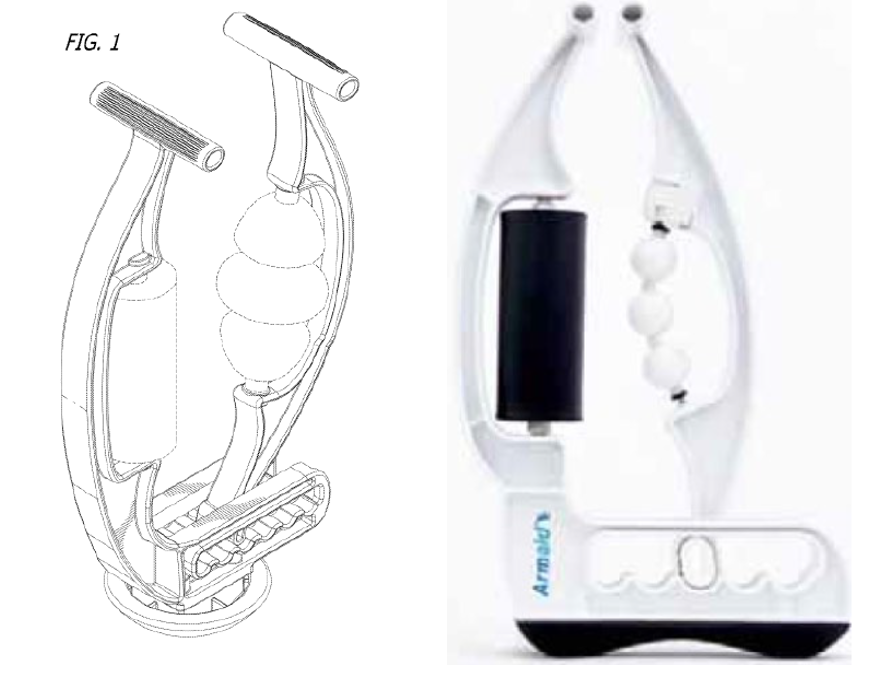
The Federal Circuit agreed that the shape of the arms is functional based in part on the accused infringer’s “concomitant utility patent[]” including claims to “limb-massaging apparatus[es]” with arms described as shaped and dimensioned for adjustably clamping a limb.
The accused infringer’s utility patent was cited during prosecution of the asserted design patent but was not related to the asserted design patent either by patent family or ownership. Notwithstanding, the Federal Circuit cited the District Court’s reasoning that the asserted design patent is the “progeny” of the accused infringer’s utility patent and therefore “inherited” the functional aspects of the arms.
In other words, the existence of a concomitant utility patent—one factor to consider when determining whether a patented design is dictated by function—apparently need not be a concomitant utility patent related to the design patent family or design patent owner.
Design patent owners must therefore be cognizant of concomitant utility patents cited during prosecution of their design patent, irrespective of relationships between their design patent and the concomitant utility patent. According to the majority in RoM, utility claims or disclosures suggesting that aspects of a claimed design have specific functionality could be imputed to the claimed design.