Federal Government
Beyond the Declared Destination: What Exporters Can Really Know About Diversion
Nov 11 2026 • 12 Min Read
On October 27, 2026, the Office of Foreign Assets Control (OFAC) announced a $1,529,685 settlement with Extreme Networks over transactions involving a Russian missile and air defense manufacturer. The Department of Justice announced a non-prosecution agreement the same day. The end-user statement identified a different Russian company, but email addresses and delivery details in seven of the nine purchase orders pointed to the actual recipient. The company already had the information it needed to question the declared end user.
How much can an exporter reasonably know about where its products will end up? A company may verify its customer, screen the parties, obtain an end-use statement, and confirm delivery in the country named on the invoice. The goods can still be resold, transferred, or put to a different use. The exporter’s ability to verify those events depends in large part on the product, the distribution channel, and its relationship with the customer.
The practical issue is how far the exporter can test the customer’s account before authorizing the shipment. Some uncertainty persists even after a credible inquiry. In other cases, the uncertainty comes from a specific discrepancy the company could have investigated. That distinction matters both to the shipment decision and to any subsequent enforcement review.
The analysis here focuses on the Export Administration Regulations (EAR), with parallel considerations under OFAC sanctions. It asks what an exporter can establish from the transaction record, when the risk warrants independent corroboration, and what to do when a material question about the end user or destination remains open.
The declared destination describes where the parties intend to send the goods. Proof of delivery establishes that the shipment reached a particular location. Whether the named party received or used the goods requires separate evidence.
Goods may arrive at a warehouse and subsequently move to another country. An operating company may use some of what it buys and resell the balance. A customer may also change its plans after a lawful delivery. For the exporter, these possibilities raise distinct questions about the credibility of the proposed transaction, the identity and location of the recipient, and the disposition of the goods after delivery.
Onward movement can be lawful. The destination control statement (DCS) expressly contemplates subsequent disposition “as otherwise authorized by U.S. law and regulations.” The relevant question is whether a subsequent export, reexport, or transfer was authorized under the applicable rules.
The distinction has a practical consequence for compliance teams. If the concern is an undisclosed end user, obtaining a delivery receipt from a logistics facility leaves that concern unresolved.
Civil liability under the EAR can attach to an unlicensed export where a license was required, even if the exporter was unaware of the requirement. OFAC can likewise impose civil liability on a strict liability basis. In both regimes, the existence and quality of a compliance program can affect the penalty assessment. An exporter still needs the applicable authorization before proceeding.
Knowledge matters directly under General Prohibition 10, under end-use and end-user controls in Part 744 that turn on knowledge, and under the EAR prohibition on acting with knowledge of a violation. In those cases, the diligence record can help establish what information was available to the exporter and how it dealt with that information.
Under § 772.1, knowledge includes awareness of a “high probability” that a circumstance exists or will occur. It may be inferred from conscious disregard or willful avoidance of facts. An exporter that leaves credible indications of an unlawful destination unexamined can therefore create an evidentiary problem for itself.
BIS’s Know Your Customer guidance gives exporters a practical framework. In the absence of red flags or an express EAR requirement, the exporter generally may rely on the customer’s representations. If a red flag appears, the exporter should inquire and reevaluate the transaction. If the concern persists, the guidance calls for refraining from the transaction or referring the matter to BIS. It also cautions against self-blinding and explains that an employee’s knowledge can be imputed to the firm.
If diversion comes to light later, reconstruct the decision as it stood when the goods shipped. What information had reached the business, who had it, and what did the company do with it?
The evidence in Extreme Networks was already in the company’s records. According to OFAC, Extreme’s Russian subsidiary acquired customer contracts in 2018 and filled nine purchase orders between September 2018 and March 2022 for switches, power supplies, software, and subscriptions. The orders identified Dmitrovskiy Experimental Mechanical Plant (DEMZ) as the end user. OFAC identified MMZA Avangard as the actual recipient of all nine orders. MMZA produced missiles and air defense systems and was majority owned by Almaz-Antey, which OFAC designated in 2014. That ownership blocked MMZA under OFAC’s 50 percent rule before MMZA was itself designated in June 2022.
Seven purchase orders contained email or delivery details pointing to MMZA. On two occasions, the distributor supplied MMZA’s website, then substituted DEMZ’s website and characterized the original references as mistakes. Extreme approved the orders based on an end-user statement naming DEMZ. The statement left the discrepancies in the purchase records unresolved.
Extreme accepted a statement of facts in the non-prosecution agreement describing how employees concealed MMZA’s involvement and how the Electronic Export Information (EEI) filings falsely identified DEMZ or the distributor as the ultimate consignee. OFAC deemed the case egregious despite Extreme’s voluntary self-disclosure, citing reckless disregard and actual knowledge. It treated $487,861 of the settlement as satisfied by payments under the DOJ agreement.
The issue was which company in Russia received the equipment. Confirming delivery to Russia would have added little. Comparing the declared end user with email domains, delivery addresses, and service records could have exposed the discrepancy before the orders were approved. Support and licensing records deserve particular attention because the people seeking portal access or technical assistance may be closer to the equipment’s actual use than the party that placed the order.
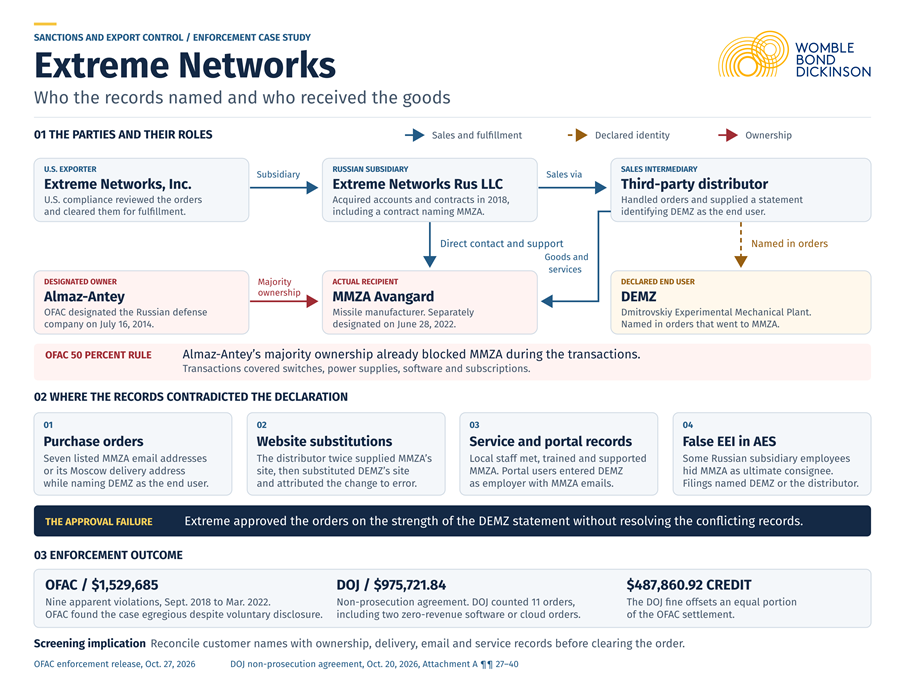
MMZA’s ownership determined its status under OFAC sanctions. BIS’s September 2025 Affiliates Rule takes a related approach under the EAR. It extends certain restrictions, including those of the Entity List and Military End-User List, to foreign entities owned 50 percent or more by covered parties and adds a related red flag to BIS’s Know Your Customer guidance. BIS suspended the rule for one year in November 2025, with the suspension scheduled to end on November 10, 2026. A two-month extension of the U.S.-China trade truce announced in September could move that date to January 10, 2027. As of this writing, BIS has yet to publish a notice changing the date.
Ownership already matters for sanctions screening. Exporters selling into China and other higher-risk markets can use the suspension period to determine whether their screening processes can identify the relevant owners, resolve gaps in ownership data, and document the basis for a clearance decision.
An incorrect recipient in the commercial record can become an incorrect ultimate consignee in the EEI. Extreme shows how the same facts can give rise to both a diversion issue and potential misrepresentation exposure under § 764.2(g) and the Foreign Trade Regulations.
In a routed export transaction, the authorized agent files the EEI using information supplied in part by the U.S. principal party in interest (USPPI). A forwarder or carrier acting as filing agent may have limited access to the sales correspondence that explains who is actually receiving the goods. An exporter should treat a change to the ultimate consignee, or a material inconsistency among the ultimate consignee, ship-to, sold-to, and bill-to parties, as a reason for review before filing.
Consider a distributor in a transshipment hub buying integrated circuits covered by Tier 1 of the Common High Priority List under HTS heading 8542. The company is duly registered, it pays its invoices, and screening yields no relevant match. In six months, its orders triple, a newly formed affiliate takes over purchasing, and delivery shifts to a third-party warehouse near the airport. Each change could have an ordinary explanation. Taken together, the changes warrant inquiry into who is buying the goods, what is driving demand, and where the goods will go.
Can the distributor identify the customers or industries driving demand? Do its staffing, facilities, and inventory turnover support the volumes it is ordering? What explains the change in purchaser and delivery location? National trade statistics may suggest that imports exceed plausible domestic demand. Determining where a particular shipment went requires evidence tied to that shipment.
The facts needed to test the explanation depend on what the distributor claims. If a new industrial project accounts for the order, confirm that the project exists and needs the items in question. If the distributor serves a regional market, ask which markets it serves and how the onward sales are handled. Delivery to a warehouse is consistent with stock distribution. A claim of manufacturing at that same address calls for evidence of an operating facility.
A genuine distributor can serve established customers and also supply an undisclosed procurement network. Its legitimate business may explain the volume of purchases while leaving open how it allocates the goods. Where buyers in restricted markets pay a substantial premium, that incentive is relevant even if the distributor has the capacity to serve local demand. An established relationship is one piece of evidence in the review of a new order.
The March 2023 Tri-Seal compliance note flags third-party payments, changes to shipping instructions, and reluctance to disclose end use. It also recognizes the limits on visibility in complex distribution chains. A single indicator may have an ordinary explanation. When several appear together, the inquiry should address how they relate to each other and to the transaction as a whole.
An invoice, a signed certificate, and an email may all reflect information supplied by the same intermediary. Agreement across those records can establish consistency. Independent corroboration requires a source with its own basis for knowing the fact in question.
Match the verification to the open question. An independent facility assessment can help establish whether a site can operate the equipment. Contact through a separately verified channel can help establish whether the named company placed the order. Delivery records tied to serial numbers provide stronger evidence of receipt, and installation and maintenance records can help establish where particular units were put into service.
BIS’s May 2025 guidance on advanced computing integrated circuits recommends assessing whether customers have the data center infrastructure to use what they order. It identifies site visits and independent auditors as ways to test customer attestations. The degree of verification appropriate for another product will depend on its sensitivity, how it is used, and the risks of the transaction.
In charges announced on March 19, 2026, DOJ alleged that a co-founder of a U.S. server manufacturer, a company manager, and an outside broker diverted at least $510 million in servers to China. According to the allegations, they staged thousands of nonworking replica servers for an August 2025 audit and relabeled some of the same units for a subsequent Commerce Department inspection. The allegations illustrate how people familiar with an audit can prepare the evidence an inspector expects to see, particularly if they work inside the company. AI raises a related concern about the ease with which a counterparty can produce credible-looking documents or images.
Where the risk warrants it, verification should rely on people outside the sales relationship and evidence that can be authenticated against specific units. Direct contact with technical staff or a check against independently maintained equipment records may answer questions that additional photographs from the same intermediary leave open.
A distributor buying for inventory often has no identified end user at the time of purchase. Requiring a final-user certification at that point can produce a statement neither party can substantiate. The diligence should reflect whether the customer is buying for its own use, filling an identified resale order, or buying for stock.
Where lawful and commercially feasible, an exporter can review downstream sales records, reconcile inventory, verify selected customers, and investigate changes in ordering patterns. Those measures should focus on the products and relationships that present the greatest risk. For a sensitive sale, the exporter may need to hold the shipment pending identification and verification of the end user or receipt of any required license.
Audit rights have practical value when the exporter can obtain usable records and act if the distributor fails to cooperate. The agreement should specify which records can be requested, when they must be produced, and what happens if a material concern remains unresolved. A refusal warrants escalation, with due consideration of legitimate confidentiality constraints.
The product itself affects what can be verified. A machine that requires commissioning, calibration, and periodic service offers several opportunities to confirm its location and use. Small components moving through multiple intermediaries may generate very little information after delivery. The oversight plan should reflect what the product and channel allow the exporter to observe.
Before opening an inquiry, the compliance team should be clear about what evidence would support release and what findings would trigger a hold, a licensing review, or a decision to decline the sale.
The decision record should identify the concern, the evidence obtained, why the explanation was accepted or rejected, and any conditions on further supply. It should also identify material questions that remain open and explain how they affected the decision.
Sales may learn that a customer refused a technical discussion. Finance may see an unexplained third-party payer. Logistics may receive revised delivery instructions. Each detail may appear routine in isolation. BIS’s guidance on employee knowledge and self-blinding makes it important to consider the information held across the firm. Compliance needs access to those records and the authority to hold a shipment while it investigates.
If a material concern remains unresolved, the Know Your Customer guidance contemplates referring the question to BIS and waiting. BIS can also inform the exporter that a license is required for a particular party or transaction. If a potential violation has already occurred, the exporter should assess voluntary self-disclosure in light of the facts and the applicable enforcement guidance.
An exporter’s visibility after sale will vary. Its responsibility before shipment is to use the information it has, investigate material discrepancies, and determine whether the transaction can lawfully proceed. If diversion later comes to light, the question the company should be able to answer is straightforward. What evidence justified releasing the shipment at the time?
If you have questions about the issues raised in this alert, please contact the authors or the Womble Bond Dickinson attorneys with whom you normally work. Click here to learn more about Womble Bond Dickinson’s International Trade and National Security practice.
OFAC, Extreme Networks, supra note 1.
OFAC, Extreme Networks, supra note 1 (voluntary self-disclosure, egregiousness determination, aggravating factors, and credit for payments under the DOJ agreement).
Tri-Seal Compliance Note, supra note 16, at 2 and 3.
15 C.F.R. pt. 732, supp. no. 3, paras. (a)(3) and (4) (2026) (self-blinding and imputation of employee knowledge).